
Note to readers: I am on break until after Labor Day; but given all the chatter about Medicare for all, I wanted to share my perspective from 20 summers on Canada’s doorstep.
My family spent 20 summers in Whitefish, Montana, 50 miles south of Canada and only four hours from Calgary and its 1.7 million people. Given the myriad attractions of Whitefish and Glacier National Park, there is a massive Canadian presence during the summers. However, many Canadians also come for the medical care.
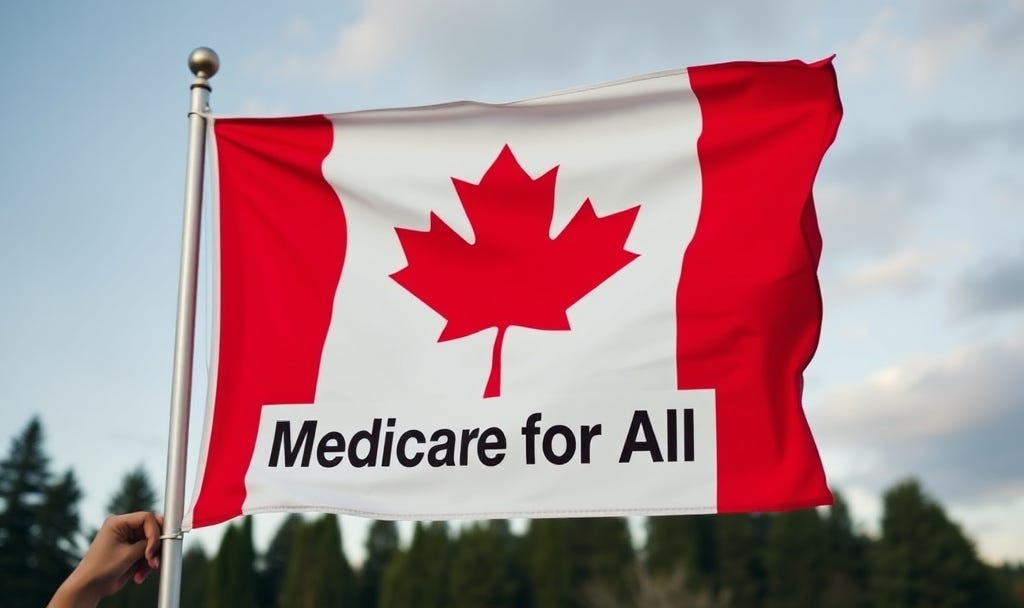
I always asked our northern neighbors how satisfied they were with the state run healthcare. Of the many I queried, only 2 said they were satisfied. The first said he liked the care in Canada, but always came to Montana when the waits were too long. The second defended the system by saying it was good at triage, i.e. if your condition seriously deteriorated, they would try to move you up on the waitlist.
Serious Systemic Problems
The core problems with Canadian Medicare are deeply embedded – limited capacity, slow patient flow1, rising demand, ageing population, government inertia and long wait times. Following are some of the specific problems.2
-
Too few hospital beds forces patients to wait to be admitted to a hospital.
-
Emergency departments are overwhelmed with lengthy wait times.
-
There are shortages of primary care doctors, thus pushing patients into emergency rooms for care that should have been handled in primary care. This, of course, exacerbates the wait times for emergency care.
-
Long-term care and home care are dysfunctional. This keeps acute care beds occupied longer than necessary and slows care throughout the system.
-
There are long waits for diagnostic imaging which slows treatment.
-
A dire shortage of specialists results in an average wait time of 30 weeks and as long as 77.4 weeks in some provinces.
There are only 400 MRI machines in all of Canada – less than in Los Angeles, Chicago, Houston or Dallas – where same day service is the norm.
Typical Wait Times
Following are some current wait times for various medical procedures.
Specialist consultation: 30 weeks
Orthopedic surgery: 57 weeks
Cataract surgery: 20 weeks
Hip replacement: 40 weeks
MRI and CT scan: 22 weeks
Emergency room: up to 24 hours
There currently are 5.8 million, or 1 in 8, Canadians on some form of medical waitlist. The equivalent number for the USA would be 43,750,000!
Confiscatory Taxation
Not only is Canadian healthcare dysfunctional, it is uber-expensive. The federal income tax rate (middle bracket) is 26%; provincial rates add another 26%; payroll taxes add 8%; healthcare is 6% and there is a sales tax of 15%. If you are keeping score, the total is 81%. For all that money, there are 5.8 million Canadians on medical wait lists where some inevitably die waiting for treatment.
The comparable taxes for Montana are: federal income tax (mid bracket) 22.0%, state income tax 4.7%, payroll tax (Social Security) 6.2%, Medicare 1.5% and sales tax 0%. The total for Montana is 34.4% with same day service and no waitlists. Montana delivers far superior healthcare at half the cost of Canada. No one from Montana ever goes to Canada for healthcare.
Meanwhile in Montana
In Montana many of the procedures listed above are available same day or within a few days. Moreover, the cost is affordable for Canadians without insurance who must pay out-of-pocket. I have heard many heart-wrenching stories about delayed healthcare from my Canadian summer friends, many of whom passionately forewarned me against Canadian style socialized medicine for the USA.
Lessons From Canadian Healthcare
It is an immutable law of economics that if something is in great demand, it must be rationed via either cost or time. Since Medicare for all is free, it can’t be rationed by cost and must be rationed by time. BINGO! How comforting it must be for the 5.8 million Canadians on waitlists to know that if their condition seriously deteriorates, they just might be moved up higher on the waitlist.
Desperate Canadians wait up to 77 weeks for treatment that is instantly available just 50 miles south in Montana – and for half the taxes Canadians pay. Free medical care is no good if it is inaccessible and you die on a waitlist. Keep that in mind when you hear some clueless socialist wannabe touting Medicare for all.
The US experiences the same problem in government run programs such as the VA, where some doctors see only 8 patients a day versus up to 40 per day in the private sector.
Sources for Canadian data are the Canadian Institute for Health Information (CIHI) and the Fraser Institute.
[{“id”:”custom_html”,”tag”:”<a href="Read More“>Original on Substack”}]